

A New Geography of Knowledge
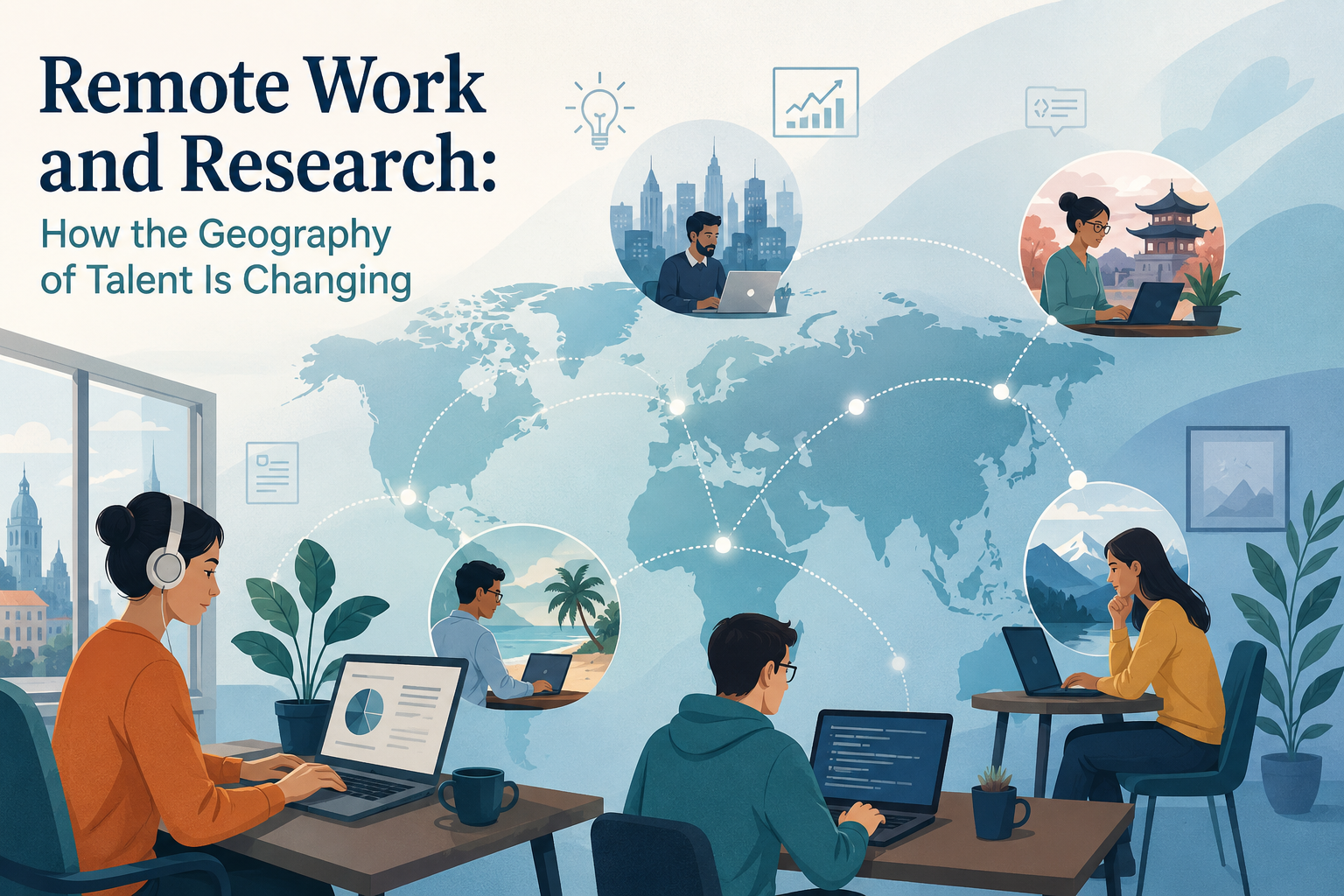
Remote work has evolved from an emergency response during the COVID-19 pandemic into one of the most significant structural transformations affecting knowledge-intensive activities. Universities, research centres, and innovative companies have increasingly demonstrated that many scientific activities—including data analysis, manuscript writing, peer collaboration, and project management—can be carried out effectively without requiring a constant physical presence. Rather than being tied to a specific workplace, research is becoming increasingly connected through digital technologies.
The numbers reflect this transformation. According to the European Central Bank, based on Eurostat data, 11.7% of employees aged 20-64 in the Euro area worked from home at least occasionally in 2019. By 2024, this number increased to 22.4%, indicating that remote work has become a lasting feature of Europe’s labour market rather than a temporary response to the pandemic. At the same time, Eurostat reports that more than half of European enterprises now regularly use online meeting technologies, while most medium and large firms provide secure remote access to emails, documents, and internal systems, creating the digital infrastructure necessary for distributed work. These trends are particularly relevant for research, where knowledge rather than physical production is the primary output.
Beyond Flexibility: Measuring Performance Through Outcomes
Remote work is often discussed in terms of flexibility, but its implications extend much further. Every unnecessary commute involves economic costs, environmental impacts, and time that could instead be devoted to research, teaching, or personal well-being. Reducing travel contributes to lower emissions: for instance, fully remote work has been estimated to reduce an employee’s carbon footprint by up to 54% compared with fully onsite work. The environmental benefits are also substantial under hybrid arrangements, with two to four remote working days per week associated with an 11–29% reduction in carbon footprint. At the same time, remote work can improve work-life balance and expand access to professional opportunities beyond major metropolitan centres.
However, remote work should not be evaluated simply because it offers greater convenience. Its effectiveness depends on whether it enables individuals and organizations to achieve comparable or even better results. In research, performance is measured through scientific indicators, which represent an important cultural shift from measuring attendance to evaluating outcomes. Recent evidence suggests that the relationship between remote work and research performance is nuanced. Venturini et al. (2025) found that remote work has substantially expanded international scientific collaborations by reducing geographical constraints, however observing a decline in citation impact, suggesting that the reduction in spontaneous face-to-face interactions may negatively affect research quality. These findings indicate that while remote work enhances connectivity, hybrid models may provide a better balance between collaboration and high-impact scientific output.
Strengthening International Scientific Collaboration
Perhaps the greatest contribution of remote work to research lies in its capacity to strengthen international collaboration. Modern scientific challenges—from climate change to artificial intelligence and public health—require expertise that no single institution or country possesses alone.
Digital technologies now allow researchers from multiple countries to join the same video call within minutes, discuss ideas, review preliminary findings, coordinate experiments, or prepare joint research proposals without the time and financial costs associated with international travel. Collaborations that previously required months of logistical planning can now begin almost immediately, making interdisciplinary and cross-border research significantly more accessible. Remote collaboration can also contribute to a more inclusive scientific environment by reducing physical barriers to participation, thus facilitating access to research activities for individuals with disabilities who may face greater challenges in attending in-person meetings and events.
Physical meetings and conferences remain essential for networking and building long-term relationships, but remote collaboration allows these connections to be maintained continuously rather than only during occasional international events.
The Challenges of Remote Research
Despite its many advantages, remote work is not without limitations. Scientific research depends not only on formal meetings but also on informal conversations, spontaneous exchanges of ideas, and the trust that develops through regular human interaction. Many innovative ideas emerge during discussions after seminars, conversations over coffee, or collaborative brainstorming around a whiteboard—experiences that remain difficult to fully reproduce in virtual environments.
Early-career researchers may face particular challenges. Doctoral students and postdoctoral fellows often benefit from observing senior colleagues, participating in the daily life of research groups, and receiving informal mentoring. A fully remote environment may reduce these opportunities while making it more difficult to develop a strong sense of belonging within an academic community.
For these reasons, many institutions are increasingly adopting hybrid models, combining the flexibility of remote work with regular in-person interaction. Routine tasks such as writing, data analysis, and project coordination can often be carried out remotely, while brainstorming sessions, mentoring, laboratory activities, and strategic discussions may benefit from face-to-face meetings.
A Strategic Opportunity for Europe
For Europe, remote work represents more than an organizational innovation; it offers a strategic opportunity to strengthen the European Research Area. Reducing geographical barriers may allow talented researchers to contribute from smaller cities and peripheral regions, rather than concentrating opportunities exclusively within a limited number of academic hubs. This can promote a more balanced distribution of talent while supporting greater participation in international research networks.
At the same time, the European Union is supporting this transformation through substantial public investment. The Digital Europe Programme allocates approximately €8.1 billion for the 2021–2027 period to strengthen high-performance computing, artificial intelligence, cybersecurity, and advanced digital skills across the European Union. The challenge is not simply to work remotely, but to create research environments that maximize scientific quality, collaboration, and human well-being.
Ultimately, technology should remain an enabler rather than the objective itself. Research continues to depend on curiosity, creativity, and critical thinking—qualities that remain deeply human. This is also the vision that guides the European Youth Think Tank (EYTT), a non-profit network connecting young researchers across Europe to promote interdisciplinary research, innovation, and international scientific collaboration. As remote work reshapes the geography of talent, initiatives such as the EYTT demonstrate how digital connectivity can be transformed into meaningful scientific cooperation, strengthening a more integrated, collaborative, and resilient European research community.
Luigi Capoani is an economist, researcher, and lecturer in International Economics at Ca' Foscari University of Venice. He earned his PhD in Economics from the University of Salerno through an international joint-supervision program with the University of Birmingham. He is the founder and president of the European Youth Think Tank (EYTT), a non-profit organization and independent platform that connects young researchers from across Europe and promotes interdisciplinary projects in research, innovation, and international scientific collaboration.
Chiara Ghirardini is a data scientist and analyst whose work focuses on the technological and organizational transformations shaping the fields of data analysis, artificial intelligence, and digital innovation.
Image by EYTT