

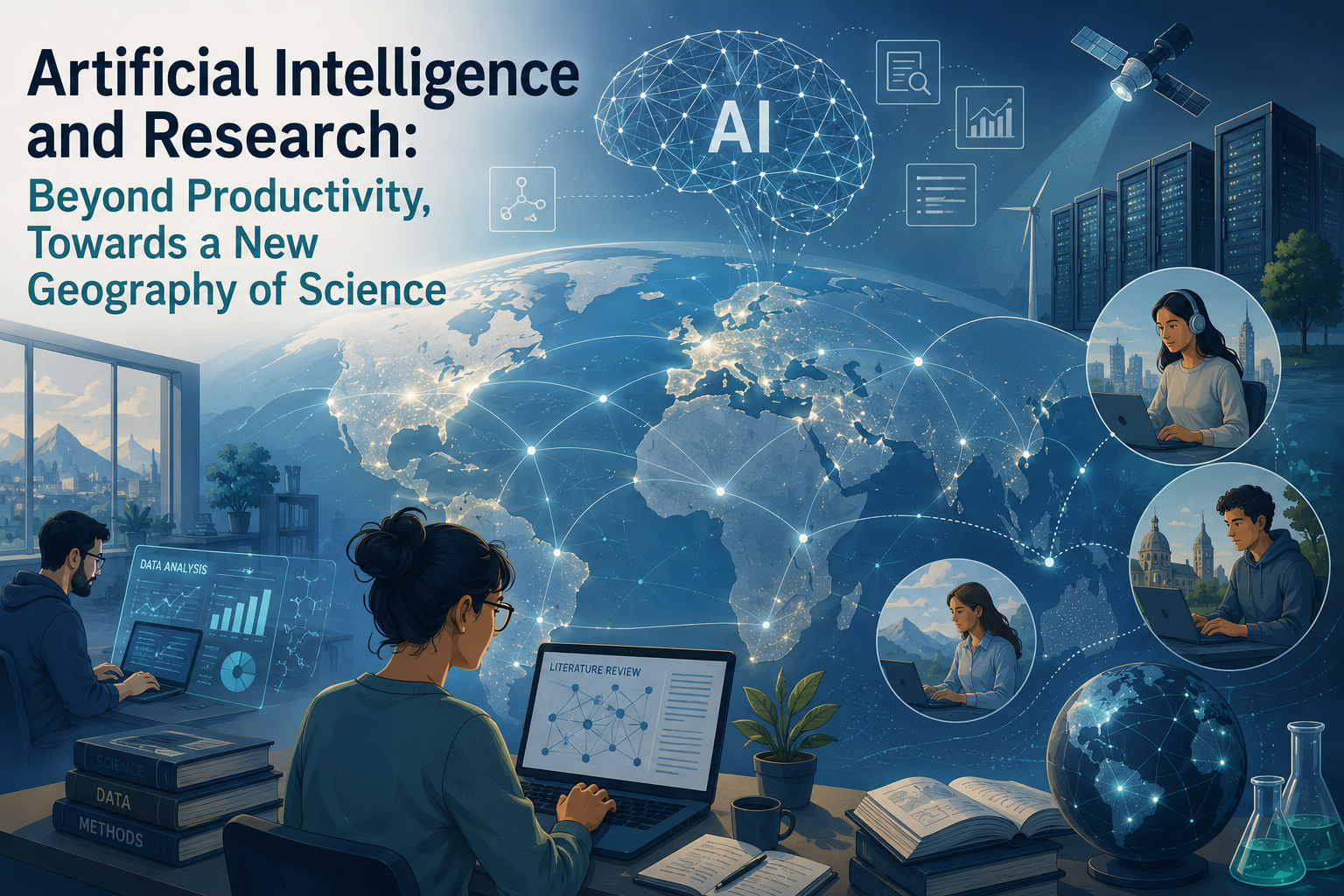
Artificial intelligence (AI), particularly through Large Language Models (LLMs) such as ChatGPT and Claude, is transforming scientific research in ways that extend far beyond the adoption of new digital tools. While much attention has focused on the productivity gains offered by these systems, AI is also reshaping the geography of research itself. Scientific competitiveness increasingly depends not only on access to talented researchers but also on access to computational resources, advanced semiconductors, cloud infrastructures, and large-scale data centers. These infrastructures are unevenly distributed across the world, adding an important geopolitical dimension to the development of AI. Their governance and accessibility can therefore become influential factors in strategic decision-making and international scientific competitiveness. A relevant example is provided by the introduction of U.S. export controls on semiconductor manufacturing technologies to China, showing how access to key AI infrastructure has increasingly become an instrument of strategic policy.
From our perspective, these developments are redefining how knowledge is produced, where innovation takes place, and how researchers collaborate across borders.
Artificial Intelligence as a Skill Multiplier
Artificial intelligence has now become part of the daily activities of many researchers. From literature reviews and data analysis to the synthesis of scientific evidence and the revision of manuscripts, AI-powered tools allow tasks that once required days of work to be completed in a matter of hours.
Nonetheless, productivity alone should not be considered the primary objective. Saving time only creates value if the quality of scientific work is preserved - or improved. AI-generated outputs should therefore be understood as a starting point towards a finished product: AI can in fact accelerate specific stages of the research process, however its outputs still require careful verification and validation. The relevant productivity gain therefore does not lie on eliminating these essential steps, but rather in reducing the time required for research intensive tasks while preserving methodological rigor.
As a result, the impact of artificial intelligence is not the same for everyone, as AI tends to reward those who already possess strong disciplinary expertise and who are able to use these tools critically and consciously. Researchers with deep knowledge of a subject are better equipped to formulate effective questions, verify the information they receive, and identify potential errors, inconsistencies, or biases in AI-generated outputs. For this reason, artificial intelligence does not replace expertise. On the contrary, it adds to it.
The Physical Geography of Artificial Intelligence
Although AI is often perceived as an entirely virtual technology, its operation relies on physical infrastructures. Every interaction with a large language model requires enormous computational resources hosted through globally connected data centers. These facilities consume substantial amounts of electricity and water for cooling and depend on advanced semiconductor technologies concentrated in only a handful of countries. Their growing resource requirements also raise concerns about pressure on energy and water supplies, particularly in regions where such resources are already constrained: as AI infrastructure expands, competition for such resources could become an additional factor shaping where data centers can be developed and operated.
Consequently, the geography of artificial intelligence is increasingly becoming a geography of infrastructure, investment, and strategic autonomy. Access to computing power may soon become as important for scientific competitiveness as access to laboratories, research funding, or highly qualified researchers. For Europe, strengthening domestic AI infrastructure is therefore not only an economic objective but also a strategic necessity.
Understanding the Limits of Large Language Models
At EYTT, we are deeply interested in the future potential of artificial intelligence and its applications in scientific research. At the same time, we believe it is important to maintain a realistic perspective on its current capabilities.
Large Language Models (LLMs) are based on sophisticated statistical models trained on enormous quantities of text. Rather than reasoning as humans do, they identify statistical patterns in language and predict which word is most likely to follow the previous ones. This process enables them to produce grammatically coherent and often highly convincing responses, despite lacking any genuine understanding of the concepts.
A plausible answer, however, is not necessarily the correct one. LLMs can generate sentences that sound authoritative while lacking the conceptual awareness required for genuine reasoning. It displays a lack for consciousness with little intentionality, and the type of creativity that allows human beings to assign meaning to information and develop genuinely original ideas. In a way, the lack of genuine contextual understanding is analogous to Hypnopedia (sleep learning) in Aldous Huxley’s Brave New World, in which ideas are just memorized and repeated but not understood.
Although AI models vary considerably in their capabilities (with some performing better in reasoning, coding, or literature analysis), currently available ones generally lack the depth of expertise that domain specialists possess. Human expertise therefore remains essential to provide the context and specificity needed to formulate relevant questions and critically interpret their outputs, which makes the role of researcher central to their use. The quality of the final outcome depends not only on the algorithm but also on the user's ability to guide it, verify it, and interpret it critically. For example, asking a broad question such as "Explain the European economy" is likely to produce a generic answer. In contrast, requesting evidence on a specific policy, supported by peer-reviewed literature published within a defined time period, is far more likely to generate a useful starting point. Even then, researchers must verify references, confirm quotations, and critically assess the arguments presented.
Peer Review in the Age of AI
The increase in productivity made possible by artificial intelligence also raises new challenges for scientific evaluation. Even before the widespread adoption of AI tools, the global volume of scientific publications had already reached several million articles per year, raising concerns about “science overload” and the sustainability of existing evaluation mechanisms. As AI-assisted writing becomes more common, this trend may further increase the pressure on peer-review systems and traditional mechanisms of quality control.
One concrete challenge concerns the reliability of AI-generated references. Large language models have occasionally produced citations to papers that do not exist or have inaccurately attributed findings to real publications. In response, scientific repositories such as “arXiv” have strengthened their screening procedures to identify submissions containing fabricated references or undisclosed AI-generated content. These developments illustrate that maintaining scientific integrity increasingly requires not only human reviewers but also new verification tools and greater transparency regarding the use of AI during manuscript preparation.
At the same time, AI also raises a broader scientific question. If increasingly complex models are capable of generating accurate predictions without offering interpretable explanations, researchers may obtain useful results while learning relatively little about the underlying mechanisms. Scientific progress depends not only on prediction but also on explanation, theory building, and the ability to formulate entirely new questions and tasks that continue to rely fundamentally on human exploration behind creative pursuits.
A Challenge and an Opportunity for Europe
Artificial intelligence is redefining the way knowledge is produced, shared, and valued.
For Europe, this represents a major opportunity. On the one hand, AI can increase research productivity and accelerate innovation. On the other hand, Europe must also invest strategically in computing capacity, digital infrastructure, semiconductor production, and trustworthy AI ecosystems if it wishes to remain scientifically competitive. Initiatives such as the AI Act and growing investments in European supercomputing infrastructure demonstrate that technological leadership increasingly depends on both human capital and physical infrastructure.
Despite all technological progress, research remains fundamentally a human endeavor, driven by curiosity, critical thinking, and the ability to imagine what does not yet exist. As one commentator recently observed, "datasets by their very nature are backward-looking, while creativity is forward-looking." Artificial intelligence is able to analyze existing knowledge at extraordinary speed, but imagining genuinely new scientific paradigms remains a uniquely human capability. This conviction also underpins the work of the European Youth Think Tank (EYTT), a non-profit organization that brings together young researchers from across Europe to promote interdisciplinary research, innovation, and international scientific collaboration. Rather than viewing AI as a substitute for human intelligence, we see it as a powerful tool that - when used responsibly can enhance scientific discovery while keeping human judgement, creativity, and critical thinking at the centre of Research and Development.
Luigi Capoani is an economist, researcher, and lecturer in International Economics at Ca' Foscari University of Venice. He earned his PhD in Economics from the University of Salerno through an international joint-supervision program with the University of Birmingham. He is the founder and president of the European Youth Think Tank (EYTT), a non-profit organization and independent platform that connects young researchers from across Europe and promotes interdisciplinary projects in research, innovation, and international scientific collaboration.
Chiara Ghirardini is a data scientist and analyst whose work focuses on technological and organizational transformations shaping the fields of data analysis, artificial intelligence, and digital innovation.