
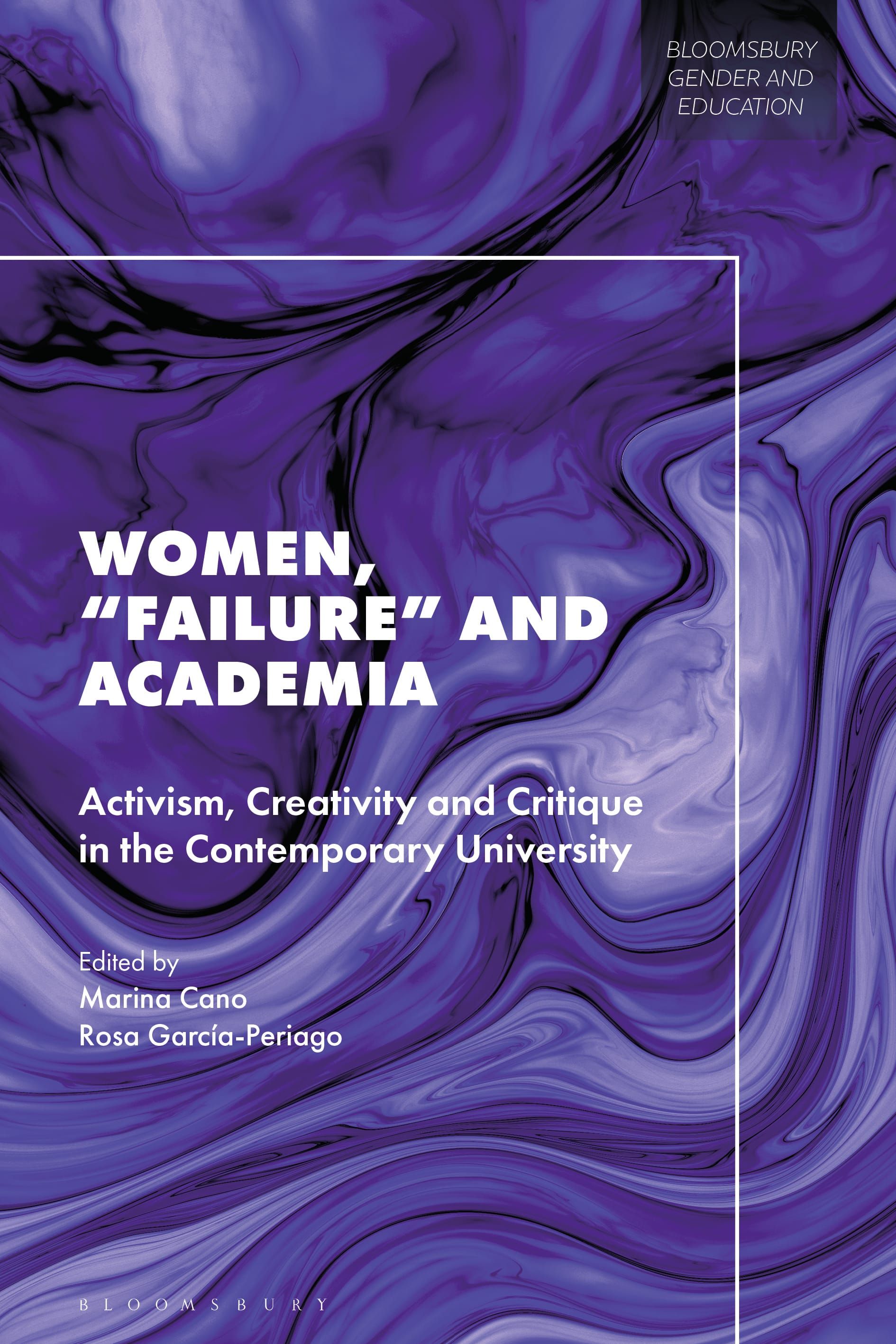
Failure happens often in academia, yet we rarely talk about it. Instead, academics appear to avoid admitting failure, as conversations center around announcements of our successes. Here, we interview Dr. Marina Cano and Dr. Rosa García-Periago about their book: Women, “Failure” and Academia: Activism, Creativity and Critique in the Contemporary University.
Dr Marina Cano is an Assistant Professor of English at the University of Valencia. She has taught at universities in Scotland, Ireland and Norway. She is the author of Theatrical Afterlives: Nineteenth-Century Women’s Novels on the Stage (Oxford University Press 2026), and Jane Austen and Performance (Palgrave 2017). She is also the co-editor of Jane Austen and William Shakespeare: A Love Affair in Literature, Film and Performance (Palgrave 2019).
Dr. Rosa García-Periago completed her doctoral studies on Shakespeare, Bollywood and beyond at the University of Murcia, where she is a Senior Lecturer. She was formerly an EU Marie Curie Individual Fellow (”Shakespeare and Indian Cinematic Traditions”) at Queen’s University Belfast. She is co-editor of Jane Austen and William Shakespeare: A Love Affair in Literature, Film and Performance (Palgrave, 2019), Women and Indian Shakespeares (Bloomsbury, 2022) and the special issue “Adapting Shakespearean Romance in Indian Cinema” for Shakespeare (Taylor and Francis, 2025). She has published extensively on Indian Shakespeares in Adaptation, Shakespeare, Atlantis, Borrowers and Lenders or Cahiers Élisabéthains, among others.
Alright, the above are our “official” academic biographies: unavoidably summaries of successes that obliterate our failures. But is this honest? Should we write instead a biography of failures, in keeping with this piece and our edited collection Women, “Failure” and Academia? Perhaps we should tell you, dear reader, about rejections and things gone wrong, about what we didn’t get as well as what we did.
Rosa: In fact, the writing of this very collection came with its own set of failures! One of the most important ones for me was not being able to write the chapter on motherhood I had originally planned. Such a chapter would explore some of my biggest fears and disappointments at a personal level I was not ready to face. So, dear reader, our failures are even present in the table of contents with the lack of a chapter on motherhood. We’ll let you read between the lines in what follows and also in the book for more failures. It’s all there.
Welcome Dr. Cano and Dr. García-Periago. We are very excited to talk to you about your latest book.
The title of the book is very thought-provoking, especially given the central theme of “failure”. Let’s start by defining failure as a concept:
Marina: That’s such an excellent question! We talk about failure all the time and think that we know what we mean by it (more or less). But failure is eminently hard to define. In the book, we follow the Cambridge dictionary, which gives us two main senses of the word: failure as “an inability to do something,” and failure as “not doing something that you must do or are expected to do.” We combine both senses in the book, but mostly the latter. Academic failure is often about not meeting someone’s expectations, frequently our own.
By the way, even our use of the Cambridge dictionary, rather than the more standard Oxford English dictionary (OED), is a sign of failure. We didn’t have access to the OED at the time we were writing the book’s introduction! Either through institutional failure (in the case of one of us) or academic unemployment (in the other). The OED is not free whereas the Cambridge dictionary is. This tells us that there is a hierarchy of knowledge: about who gets to access which resources and who doesn’t, and what further implications that can have. The more resources one can access, the greater the chances of potential success!
Could you guide us through the different elements that contribute to failure in academia and how they affect women in particular?
Rosa: Failure in academia is mainly influenced by the neoliberal structure of modern universities, where success is measured through the number of publications, funding and impact. These expectations create constant pressure, so it is very easy for us academics to feel we are failing if we do not meet these benchmarks. The well-known expression “publish or perish” encapsulates this intense pressure in academia to constantly publish in high-impact journals to secure career advancement. As our collection demonstrates, this culture can cause many problems, one of them being burnout. Therefore, we show how failure is structural and systemic rather than individual and how the system needs to change. I hope our collection offers some food for thought and contributes to rethinking academic culture.
"As academics we are trained to ignore our own embodiment in the pursuit of the 'life of the mind', and we continually push beyond our limits in attempting to juggle increasing demands. Such a claim brings to mind that well-known adage, attributed to the Duchess of Windsor: ‘One can never be too rich or too thin.’ To paraphrase: one can never have enough publications, enough grants, enough honours, or enough time to achieve them all; anything else is a potential academic failure. Yet, if nothing is ever enough, we must be failing all the time, as indeed we are." (Cano and García-Periago, “I Regret to Inform you…An Introduction to the Politics of Academic Failure,” pp.5-6)
Marina: What research shows is that women are more likely to fail in academia, as is any scholar belonging to an underrepresented group. For example, women and scholars of colour find themselves on precarious contracts more frequently than their white male counterparts. Of course, failure can, and does, affect everyone in academia, but if you belong to a group or have an identity that Western societies have tended traditionally not to privilege, you’re more likely to “fail” or be thought to fail. One of our contributors, for instance, writes about being a woman academic from a working-class background (Theadora Jean, Chapter 4); two other contributors write about being women of colour of migrant backgrounds (Dinithi Bowatte and Helen Yeung, Chapter 7). This is not a coincidence.
Your book proposes that we embrace failure as a form of empowerment or even activism. Can you share an example where failure is seen as a form of defence or transformation for you or individuals around you? How did this experience affect your view of failure?
Marina: I can give an example from my own chapter contribution, Chapter 1 “Whorademia: Deluxe Professionals for Hire.” I interviewed women temporarily employed in academia–i.e., on fixed-term contracts, hourly-paid contracts and any other form of casual employment at university. One of them, a migrant woman, had been temporary for years. Happily, her institution announced two (not one!) permanent jobs to teach the same courses she was then teaching. She applied but was not even shortlisted. Next that institution offered her a temporary contract–one more–to cover those same courses, which the “successful candidates,” those who got the jobs, were not immediately ready to teach.
Now here is where we see academic failure as potentially empowering: she started playing the institution, negotiating better conditions, a greater length of contract, when she had decided to leave all along. She did receive an offer for a job outside academia on the day she was due to sign her temporary academic contract, and so she left. She basically stood that institution up, which was already counting her in for the semester and had everything ready (contract, timetable, etc.). This is, of course, a small act of rebellion (there are more like this one in the chapter), but it shows us how failure, the failure to get the job, can help us undermine academic systems.
Rosa: We can also see transformation in our collection in more creative responses to failure: turning abandoned research into new projects (Dawn Lyon, Chapter 6), or using autoethnography to challenge dominant academic norms (for example, Alexa Joubin in Chapter 8 deploys trans theory as a means to social justice in the academy).
Experiences like these have changed my understanding of failure profoundly, since it is a site of critique, creativity and even solidarity. It shows the limits of the system, something that Tara Brabazon examines in the context of the university management (Chapter 10). Failure, then, can pave the way for alternative forms of thinking beyond the academy.
How do you think about personal experiences vs critical data analyses? How did you think about integrating these in hybrid forms to discuss conventional academic expectations and breaking away from that?
Marina: This was, and is, a balancing act. The book is scholarly: we and many of our contributors use theory (failure theory, trans theory, critical race theory), but many of us also use autoethnography (the personal story, the anecdote). In a book about academia by academics, it’s hardly possible not to be personal, but is it desirable anyway? We know, at least since the 1960s, that the personal is political. We take this one step further and claim that the personal is academic and the academic is political!
How did the project start? How did the team of authors get together?
Marina: I had been thinking about failure for a long time, mainly my own professional failures and the frustration that comes with failure (of any type). Around 2021, I proposed the idea to Rosa, and I’m very grateful that she went along with my crazy idea! As we write in the book’s introduction, “the present volume originates in our own conclusions, failures and rejections, for failures are conclusions, endings or at least pauses, but…they can also lead to creative new beginnings. This book originates in our personal academic failures: the failure to secure permanent employment, the failure to mother while an academic” (pp-4-5). Then, once we agreed to dive into the idea of failure together, it took some time and some discussion to gauge the project optimally: What were we going to say about failure, what type of failure? And so on.
Rosa: It was impossible not to go along with Marina's idea, since it was just fantastic! We took our time developing it until we were really proud of the result.
The team of authors was formed through a successful call for papers, from which many of the contributors were selected. For certain topics that were not covered in the submitted abstracts, we additionally invited specific contributors with relevant expertise.
What is your advice for early-career women embarking on academic careers?
Rosa: I try to be realistic: I demystify academia and discuss its perks and - above all- its pitfalls with early-career women considering this path. The demands of today’s neoliberal university are intense, so having strong support systems is essential. I always encourage them to cultivate meaningful friendships within academia - especially with other women - because these networks can make a difference in an often unfriendly environment. And I try to set an example by having a coffee with them once a week - this creates a relaxed atmosphere where we share our main concerns and, of course, our failures.
What is the one key insight you would want your readers to take away from this? And how do you envision it being imbibed or helping them navigate their academic life?
Marina: I hope we can contribute to demystifying academic failure. We give some figures in the introduction, such as the fact that many permanent jobs in academia have around 100 applicants nowadays, sometimes more. This means that failure is inevitable, in life as in the academy. If 100 people apply for one job, 99 will unavoidably fail. The same is true about grant and fellowship applications. In short, academic failure is absolutely unavoidable but not always negative. As we show, it can also be an empowering tool we can leverage, a sign of protest and disobedience to the exigencies of the modern neoliberal university (the one that tells us that we need to succeed, succeed, produce, produce, more and more). I hope we have also helped to debunk that well-known binary failure/success, which implies they are total opposites. We propose they are complementary rather: we cannot have one without the other. They are part of one same whole.
Rosa: I would add to what Marina said that academic failure is political; it is not an exception or a personal flaw, but an inevitable feature of contemporary academia. In a system defined by neoliberalism, most people will “fail” by design. Seeing failure this way can help people feel less alone and encourage solidarity with others in similar situations. The collection shows that failure should not be treated as something negative then, as it can also lead to reflection, resistance and new possibilities.
Thank you again for joining us for this interview. We hope your book will be a great success and that it inspires us all to change the dynamics surrounding failure in academia.