


“Publish or perish”- how many of us have heard this phrase in our research journeys! Whether it's the stress of landing a full-time job after completing a PhD or securing highly competitive funding to do cutting-edge research, the pressure is overwhelming for researchers. We, in our roles as Research Development Strategists, collaborate with researchers at all career levels to help them effectively communicate their research ideas to funders. We strategize and assist researchers in writing compelling grants for various funding opportunities.
As trained scientists, we understand (and empathize) with our fellow researchers when they feel stuck or are not enjoying grant writing. In our roles, we aim to alleviate the stress researchers face and enhance their self-efficacy while infusing joy and creativity into their processes. We continuously upskill ourselves to find ways to distill the “fun” in funding for researchers. A pivotal moment in our career was when we read this transformative book, Creativity in Research: Cultivate Clarity, Be Innovative, and Make Progress in Your Research Journey by Nicola Ulibarri et al, in our office’s book club. This book was a game changer for us, empowering our approach in profound ways. Nearly every day, we find ourselves recommending this book to the researchers we work with. This book fuses the human-centered approach of design thinking with the rigorous, rational, analytical approach of the research process. Best of both worlds, if we may say so. It has transformed how we think about the research journey and has enabled us to recenter creativity at its core. It talks about how creativity is the heart of research and how researchers are not robots but “humans”.
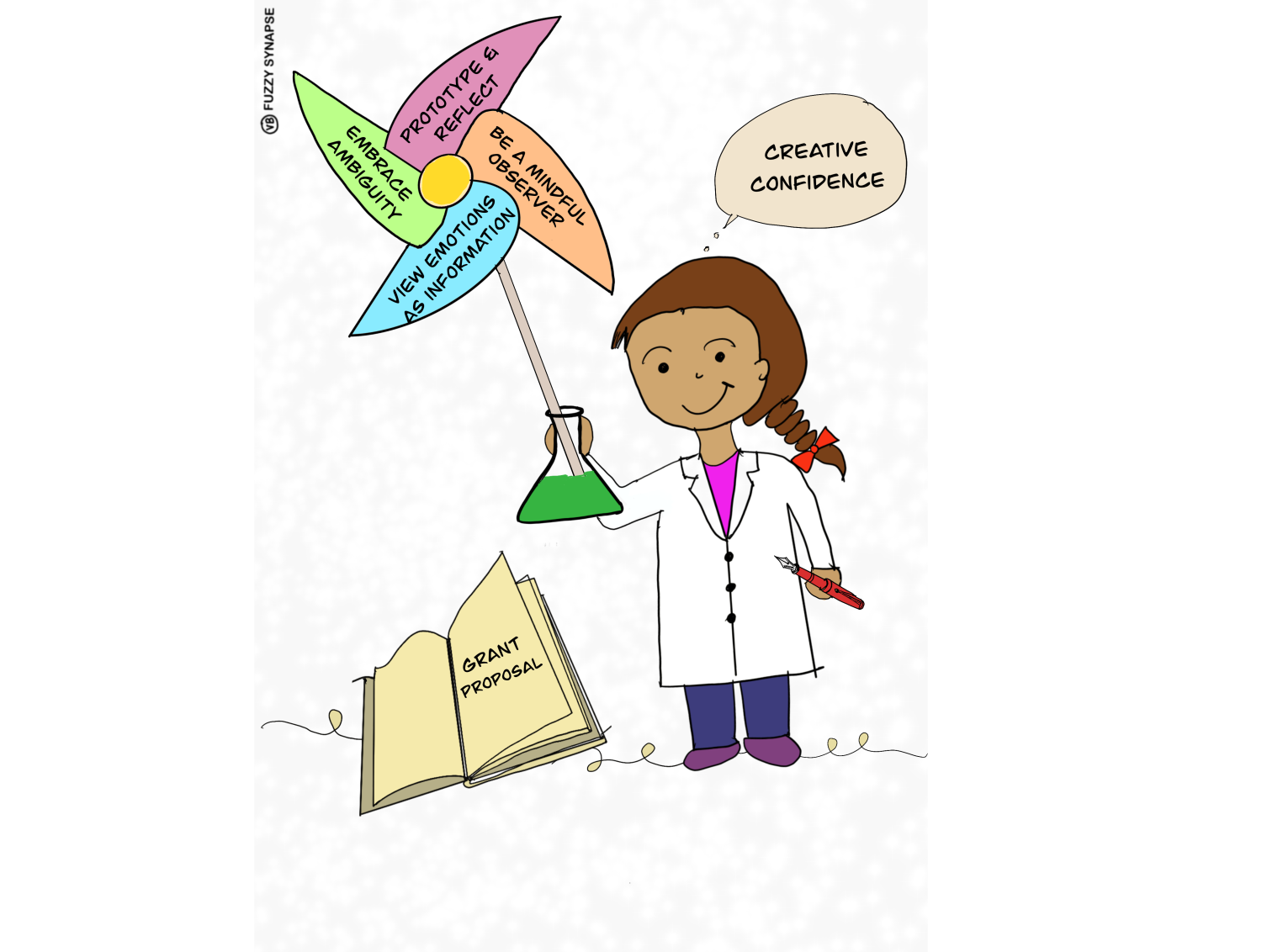
This book outlines clear concepts for enriching a scientist’s research journey with more “creative confidence”. Each chapter is packed with hands-on activities and reflections to apply the content to your own research journeys. Here we share the four foundational skills that the authors outline in the book and how we have applied these skills for grant writers to boost their creativity:
1) Be a mindful observer
The practice of mindfulness means noticing without judgment. Build a habit of pausing and paying attention to your research process, including your behavior, thoughts, and habits. This awareness helps you recognize how you approach challenges and enables you to build creativity deliberately into your research process and optimize your workflow.
How we applied this skill for grant writers:
Because grant writing is a multistep process that involves drafting different proposal components, we advise grant writers to pause and pay attention to their writing process as suggested in the book. Rather than feeling pressure to power through the day with writing, we ask grant writers to notice their process and suggest that they match their energy levels with the task at hand. This means scheduling writing sessions for the most important documents, such as Specific Aims, when feeling fresh and with a high energy level in the day. Conversely, leave the administrative tasks or boilerplate documents to lower energy states in the day. We found that applying this skill of being mindful of their energy states when tackling different tasks helped grant writers optimize their process and enjoy the writing process more.
2) Consider emotions as valuable sources of information
Emotions are a fundamental aspect of our human experience. They drive curiosity and persistence, both essential qualities for impactful scientists. Scientists who are able to acknowledge their emotions can access valuable sources of information and tap into powerful motivators for creative problem solving. Emotional intelligence enhances well-being, productivity, and creativity; thus, it must play a central role in research.
How we applied this skill for grant writers:
As scientists, our training taught us to use rational decision-making and gave the impression that it is best to exclude emotions from our scientific endeavors. Now we advise grant writers to reconnect with the motivation with which they started on their scientific path and tap into those emotions as an important source of information when writing about “current you” and “future you” in the proposals. This helps grant writers to center joy in their process. Also, as grant writers draft and revise proposal documents, we advise them to walk in the shoes of their reviewers and review their drafts from the reviewer’s point of view. Reviewers often feel busy and distracted; hence, grant writers can understand reviewers’ emotions and use this valuable information to strategize how to effectively communicate ideas through text and illustrations in their writing. Thus emotions, be it of your own or others, provide valuable information that can propel you forward and help you to relate better to your reviewer.
3) Become more comfortable with ambiguity
The research process requires narrowing a field(s) to a research question, making a prediction / formulating a hypothesis, deciding on an approach, and then testing. However, there are many potential paths a scientist can take in developing their research question(s) and approach(es). We have seen many scientists, from graduate students to faculty, struggle in research because of this inherent ambiguity or uncertainty. By leaning into ambiguity and becoming more comfortable with it, scientists can ultimately ensure they are asking the right questions. In research, broadening your scope to a larger problem space means your impact moves beyond just incremental progress.
How we applied this skill for grant writers:
To embrace ambiguity, we advise grant writers to develop potential proposal ideas with the “yes, and…” strategy, which was popularized by improvisational comedy. Next time a mentor or collaborator presents an idea or suggestion for a potential research direction, say "Yes, and..."to acknowledge and validate their contribution and build upon it. “Yes, and…” is generative and moves conversations forward, fostering inclusivity and collaboration, rather than “but,” which hinders the flow of ideas. This approach affirms their input and opens the door to expanding and enriching the idea with further insights and creativity.
4) Refine your ideas via cycles of prototyping and reflecting
It’s counterintuitive, but adopting an iterative approach, or failing incrementally, is powerful in research. Greater progress is enabled by cycling through prototyping and reflecting because you can learn quickly and tweak to a better version. Instead of focusing on finding the “right” answer from the start, generate many ideas, then converge on a few, and use a prototype to test a couple. Reflect on what you learned and iterate to refine that idea.
How we applied this skill for grant writers:
To develop this ability to prototype, we advise grant writers to view their writing as an iterative process. We ask them not to worry about crafting perfect sentences; rather, aim to develop a writing routine to quickly test and iterate prototypes of their drafts without judgment. We suggest they seek feedback on drafts from a wide audience, e.g., mentors, advisory teams, labmates, peers, colleagues, etc., and then further revise and edit. Similarly, we ask grant writers to view feedback from reviewers as just another cycle of prototyping. Categorizing reviewers’ feedback into themes, prioritizing responses, and addressing comments helps grant writers submit a stronger proposal.
Conclusion
In addition to the recounted foundation skills, the authors propose support structures (craft stories to reinforce creative identities, cultivate creative states, make research a team sport) to amplify the creative abilities of researchers. We have found that these supports similarly amplify the creative abilities of grant writers, too. Within the final section of the book, common research challenges, such as choosing a dissertation topic, developing a team project, designing a new course, etc., are used to illustrate how to apply these skills and supports for more creative solutions. Although grant writing wasn’t specifically described, this book enabled us to reimagine grant writing with creativity centered at its core. In our opinion, it is recommended reading for all researchers!
Dr. Crystal Botham is the Director of the Office of Pediatric Research Development at Stanford University. She is a scientist at heart and aims to center joy in grant writing and beyond. She absolutely loves supporting K Award applicants and is proud of her K Award Guidebook: Your Guide to Launching an Independent Research Career.
Dr. Vinita Bharat is the Assistant Director at the Office of Pediatric Research Development at Stanford University. She is a trained neuroscientist and passionate communicator, provides tailored grant-writing coaching to researchers, infusing her mission of finding “fun” in funding into each session. She aims to support emerging researchers and physician-scientists in becoming independent investigators. She also runs the online science communication platform Fuzzy Synapse.
Image by Vinita Bharat.